
Short answer: a space story does not have to teach facts about planets. A funny one can simply show how ordinary Earth things look to someone who has never seen them. Here are five things Bzubzi, an alien visiting Earth, finds strange:
- Floors: if the floor stops working, the ceiling works too.
- Buttons: first he presses the button, then he observes the unexpected additions.
- Sandwiches: “a food hug.”
- Cookies: one very large cookie is much more efficient than twelve small ones.
- Picnics: why bring perfectly good food outdoors?
What would it feel like to leave Earth? What happens when there is no gravity? What does life look like somewhere else? Is there anyone out there, and would they find us as strange as we might find them?
Those were the questions that fascinated my son and eventually led me to create Bzubzi.
Who is Bzubzi?
Bzubzi is friendly, curious, extremely pleased with himself, and surprised by almost everything humans consider normal. He does not always understand Earth, but that has never stopped him from explaining it.
Tomek tries to help him understand. Lola, Tomek’s skeptical plush cow, usually suspects that Bzubzi’s next idea will end badly. She is often correct.
Here are five perfectly ordinary things that look very different through Bzubzi’s eyes.
1. Floors
Humans rarely think about floors until something is wrong with one. We expect them to remain underneath us, hold our furniture, and prevent everyone from floating toward the ceiling.
Bzubzi comes from space, where directions are more flexible. When Tomek and Lola experience zero gravity aboard his spaceship, they are understandably alarmed. Bzubzi approaches the situation differently. The floor may have stopped working, but the ceiling works too. Problem solved.
This was one of the moments my son found especially funny. Bzubzi’s conclusion is not entirely wrong. It is simply based on a very different understanding of what ceilings are for.
2. Buttons
Most children are taught not to press mysterious buttons without first asking what they do. Bzubzi has a different method. First, he presses the button. Then he carefully observes the unexpected additions.
This is how his first Earth adventure begins. Alone aboard his spaceship, Bzubzi notices a large red button he has never seen before. He does not know what it does, but he is very confident in his ability to press it. In fact, as he later explains, he pressed it extremely well.
The blackout, change of direction, and unplanned journey to Earth are therefore not evidence of poor button pressing. They are simply additional results.
3. Sandwiches
To a human, a sandwich is one of the least mysterious foods available. To Bzubzi, it requires further investigation.
There is food on the bottom. There is more food in the middle. Then another piece of food is placed on top of everything. The explanation is obvious: it is a food hug.
Children understand the logic immediately. They know that it is not the usual name for a sandwich, but they can also see exactly why Bzubzi calls it that.
That is what I enjoy most about his misunderstandings. They are not random. Bzubzi looks at something ordinary, uses the information available to him, and reaches a conclusion that makes perfect sense, from where he is standing.
4. Cookies
Humans have made baking unnecessarily complicated. A recipe may ask for twelve small cookies. Bzubzi quickly notices that one very large cookie would be much more efficient.
Unfortunately, large cookies create other questions. If everyone is supposed to receive a corner, what happens when the cookie is round?
Bzubzi is always willing to improve a human idea. The fact that nobody asked him to improve it is a minor detail.
Cooking is full of possibilities like this. Humans take perfectly good ingredients, mix them until they no longer resemble themselves, place them inside a hot box, and wait. We know this is normal because we have seen it all our lives. Bzubzi has not.
5. Picnics
A picnic may be the strangest human idea of all. First, humans prepare food inside. Then they carry it outside. Instead of eating at a table, they sit on the ground, where the food is exposed to grass, wind, and ants.
Bzubzi has questions. Why bring perfectly good food outdoors? Why sit beside it on a blanket? And why is nobody doing anything about the tiny creatures approaching lunch?
Fortunately, Bzubzi owns a device designed to keep important things safe. Unfortunately, Bzubzi’s definition of safe is very thorough. The food does eventually return.
My son asked me to read that part several times in a row: the moment the picnic falls back down. He knew exactly what was coming and laughed every time.
Why children understand Bzubzi
Bzubzi’s misunderstandings are not taken directly from things my children have said, but they are inspired by the way children interpret the world.
Children receive a little information, combine it with what they already understand, and arrive at a conclusion that is completely logical from their perspective. It may also be completely wrong. Bzubzi does the same thing, with considerably more confidence:
- When he sees a button, he presses it extremely well.
- When he sees a sandwich, he recognizes a food hug.
- When a recipe asks for twelve cookies, he finds a much more efficient solution.
His ideas grow naturally from who he is. He is not trying to create trouble. He genuinely believes he is helping. That is usually when the trouble begins.
Why I created an alien
I knew I wanted to write a special story for my son, but for a long time, I could not find the right idea. Then one day, it became obvious: an alien would show Tomek space.
In that first homemade story, Bzubzi took Tomek away from Earth and showed him what life looked like beyond our planet. In return, Tomek offered to show Bzubzi Earth. That was how their friendship began: two children from different worlds, each knowing things the other did not.
I did not want Bzubzi to be a wise alien who arrived to teach a child about the universe. I wanted him to be like my son: curious, confident, and still discovering how things work. Bzubzi knows space. Tomek knows Earth. They meet as equals.
The stories have changed and grown since that first handmade book, but this idea has remained at their center.
Space stories can simply be fun
Children can learn extraordinary things from books about space. But every space story does not need to teach scientific facts, explain the solar system, or introduce new vocabulary.
Sometimes space can be a place where the floor stops working. Sometimes an alien can visit Earth and misunderstand lunch. Sometimes a story can simply make a child laugh and ask what happens next.
That is what I want for Bzubzi. I want children to recognize his expression just before another very sensible plan begins. I want them to laugh at his explanations and wait for the next misunderstanding. Because Bzubzi may be new to Earth, but he is already certain he can improve it.
One alien. One red button. Several unexpected additions.
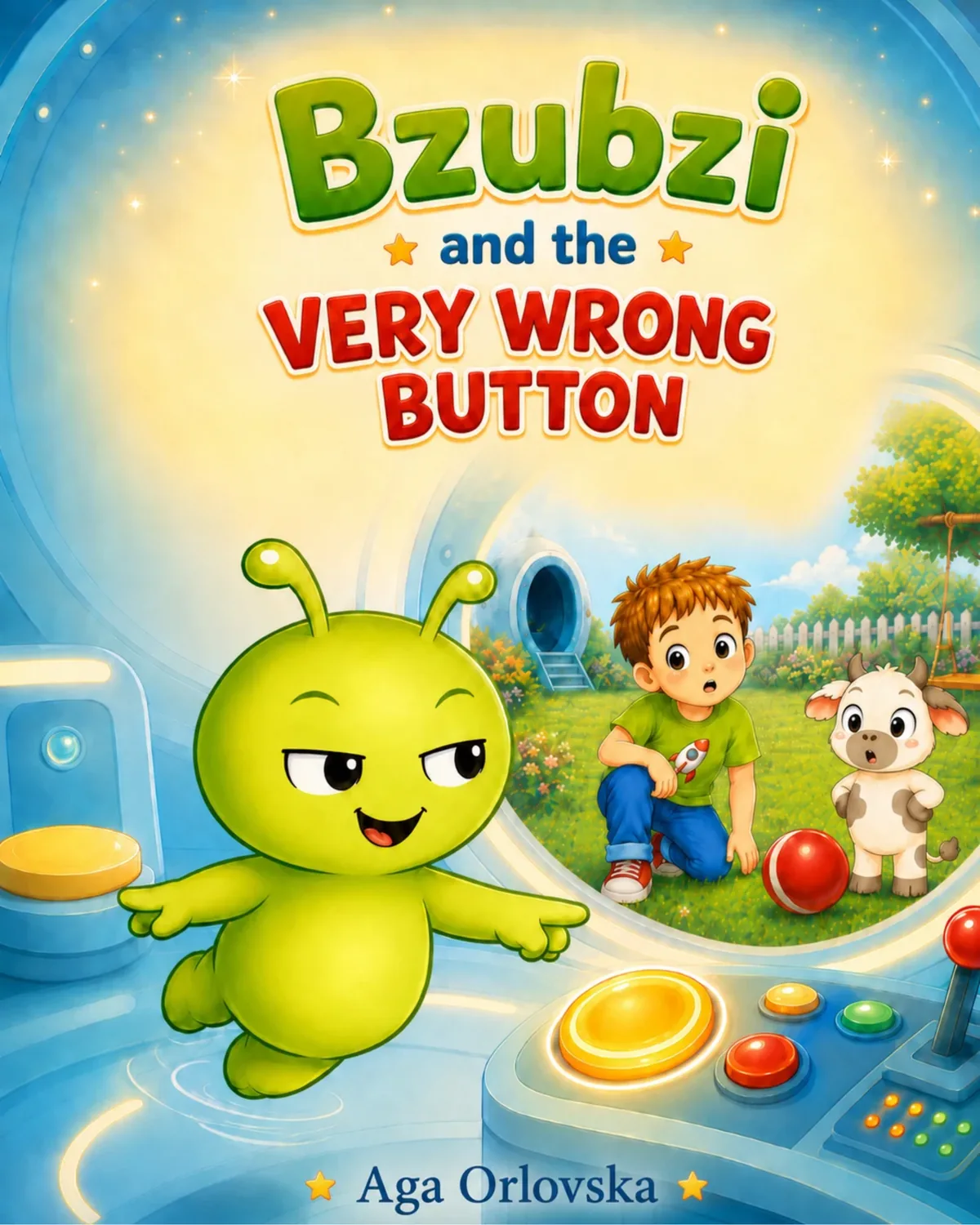
Bzubzi is alone aboard his spaceship when he notices a mysterious red button. He does not know what it does. He presses it anyway, and presses it extremely well.
After an unexpected blackout, Bzubzi arrives on Earth, where he meets Tomek, Lola, and an entire planet full of things that require further investigation.
Bzubzi and The Very Wrong Button is a complete, beautifully illustrated story for children ages 4–8. It takes approximately 10 minutes to read aloud and can be printed at home or read on your device. Free, complete illustrated PDF.
Finally, a children’s book that genuinely made us laugh.
Katherine, mom of Caroline, age 6